One focused weekend. A list of a dozen colleges where your son or daughter can actually run. Five thoughtful, informed emails ready Monday morning.
It’s Sunday night. Your kid has another meet this week. There’s a dishwasher to load and a permission slip to sign. And in the back of your head, the same thought you’ve had for three months:
“We still don’t know what their college options actually are.”
You’ve spent some time on Runcruit and tried to figure out TFRRS. Maybe you started a spreadsheet with a row for each school. But every time you sit down to make real progress on it, you hit the same wall: the information you need doesn’t exist where you can find it.
You don’t know which schools your kid actually fits at, because schools don’t list their performance standards. You don’t know which coaches to email. The head coach? The assistant? Both?
You’re not lazy. You’re not disorganized. You’re an attentive parent doing what attentive parents do, and the system is set up so that even doing everything right leaves you stuck.
A mom emailed me last week and signed it, “a very overwhelmed parent.”
That overwhelmed mom isn’t alone. Another parent asked, “Where to even start? Overwhelmed.”
A parent in upstate New York said, “I’m struggling with getting started. My son wants to run in college, but he doesn’t know what he wants to do, or where he wants to go.”
And one mom who is super organized and has a spreadsheet going wrote, “It seems daunting and more time consuming than I have the bandwidth for.”
That’s the same problem written four times by four different parents.
The information you need to make smart decisions about your athlete’s college future lives inside college programs. Not on Google. Not on Runcruit. Not in any tool you can buy off the shelf.
And until you have it, you can’t move.
Same kitchen. Same coffee. Same kid.
But the spreadsheet is closed.
In its place is a printed list of a dozen college programs you didn’t have on your radar two days ago. Every one of them is a real fit for your athlete’s PRs, GPA, geographic preferences, and what your family can actually afford.
You’ve narrowed it to the five programs you want to email first. You know exactly who to email at each school. The head coach’s email. The assistant coach’s email.
You know what to put in those emails from the video you watched on Saturday. You know what your kid’s PRs mean to those coaches, because you’ve already seen the most recent rosters at every school on the list.
Your athlete is sitting at the table next to you. They have opinions about which schools made the list and why.
You have data. You’re making the decision together.
The email gets drafted Sunday night, sitting in your drafts folder. Monday before school, your child sends them.
That’s the version of you the Clarity System is built for. Informed. Organized. Armed with a plan.
You could enroll on a Thursday, spend five or six hours over the weekend, and email coaches Monday morning.
“If we just look at enough websites, we’ll figure this out.”
You won’t.
The reason this process feels endless isn’t because you haven’t searched hard enough. It’s because the information that actually drives college recruiting decisions doesn’t live on school websites or third-party tools. Schools don’t publish honest performance standards and their roster pages don’t list high school PRs.
The data you need to make a real list lives one layer below the surface, and most families never get to see it.
“We just need our kid to run faster, and offers will come.”
PRs matter a lot. But the families who get the best outcomes aren’t always the ones with the fastest athletes. They’re the ones who matched their athlete to the right programs at the right time, and who knew how to ask the right questions about academic scholarships and need-based aid, as well as athletic scholarships when applicable.
Matching well is something you do, not something that magically happens.
“It’s still too early. We have time.”
This is the most expensive belief in the entire process, and it’s the one I see most often.
The recruiting calendar has accelerated for distance running over the last decade for the fastest athletes, which has sped up the process for everyone else.
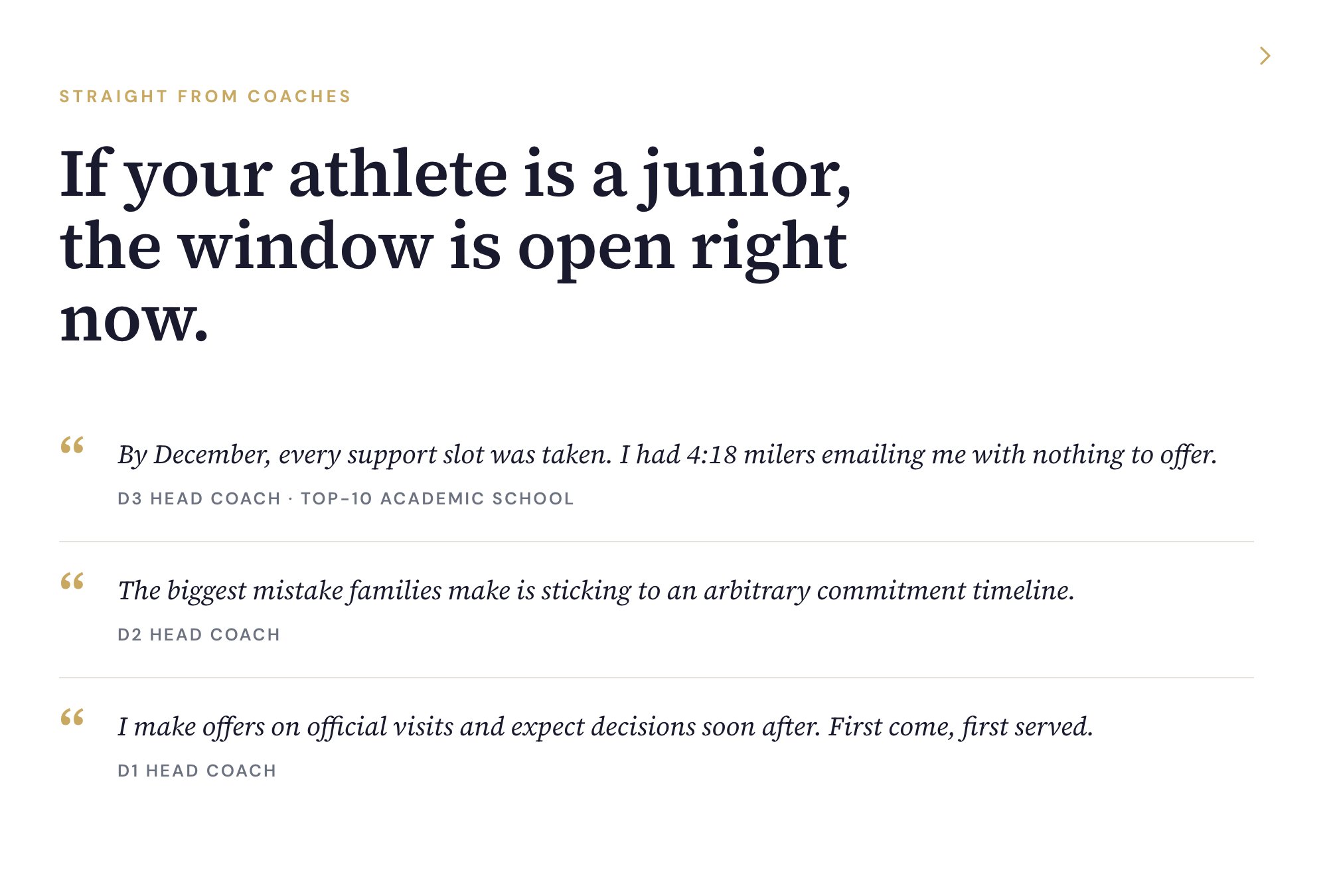
Coaches at competitive D3 programs routinely have full rosters by October of the senior year. If your athlete is a sophomore or junior right now, the window where you can actually shape the outcome is open. It’s not open forever.
Waiting until “we have a little more information” is how families lose the schools that would have been their best fit.
No spreadsheet. No guessing. No waiting.
When the target list is built on real roster data instead of website performance standards or what some online tool guessed, every downstream piece of the process gets easier. Emails only get sent to schools where your athlete is genuinely a fit. Coaches respond, because the outreach matches what they’re actually recruiting. Visits feel productive instead of speculative. Decisions get made for the right reasons.
The work doesn’t go away. You’ll still have hard conversations about money, about geography, about whether your kid should be a four-hour flight or a four-hour drive from home. But you’ll be having those conversations from a place of clarity instead of from inside a fog.
That’s the shift the Clarity System is built to create. Not in six months. Not in twelve weeks. In one weekend of focused work.
I’m Jay Johnson. I spent five years as the recruiting coordinator for the cross country and track teams at the University of Colorado. I was the person inside the office making decisions about which high school athletes to recruit, who to offer money to, and which to let walk on.
I’ve coached distance runners for over 25 years, from high school kids running their first 5K to professionals chasing Olympic standards. I wrote a book on high school distance running and I’ve done podcast interviews with coaches and Olympians you’d recognize.
And right now, I’m a parent. My daughter is a junior, she wants to run in college, so just like you, I’m going through this process.
That combination is why I built Next Mile Recruiting. The information families need to do this well isn’t hidden because anyone is keeping it from you — it’s hidden because nobody’s bothered to put it in one place. I’ve spent the last eighteen months doing exactly that.
“Coach Jay was extremely helpful to our family.
We are well into the recruiting process and needed help navigating aspects like communicating with schools, the best questions to ask, timelines, tips on making hard decisions and more.
Jay’s energy, experience, and wisdom are unparalleled in the industry.
If your family needs guidance or advice regarding XC and/or track & field recruiting, Jay is your guy.”
— Next Mile Recruiting parent
The Clarity System is four things: a self-paced course, a matching tool, a set of in-depth college program reports, and a library of college coach interviews. It’s designed to be used over a single weekend.
It gives parents of high school distance runners a working answer to the question almost no one can answer for them:
“Where can my kid actually run in college, and what do we do next?”
You could enroll on a Thursday. You sit down with your laptop on Friday evening. By Monday morning, you’ll have a personalized list of a dozen college programs that fit your athlete. You’ll know which five coaches to email first, and you’ll have those emails drafted and ready to send.
That’s not an empty marketing promise. That’s the time budget the system is built around. About five or six hours of focused work, spread across Friday evening, Saturday, and Sunday.
This first video should be mostly face to camera. Not a tutorial. Not a screen recording. Just me welcoming you in, explaining who this is for, and showing you the outcome: a real list, informed emails, and a calmer Monday morning.
If after watching this you still have a question, the answer is in the FAQ below or just email me at info@nextmilerecruiting.com and I’ll get back to you promptly.
Screen Studio or face-camera embed goes here. Suggested rhythm: who this is for, what the weekend looks like, what they will have by Monday, and why you built it.
About three hours of watch time, plus optional deep dives
Four core videos every parent watches:
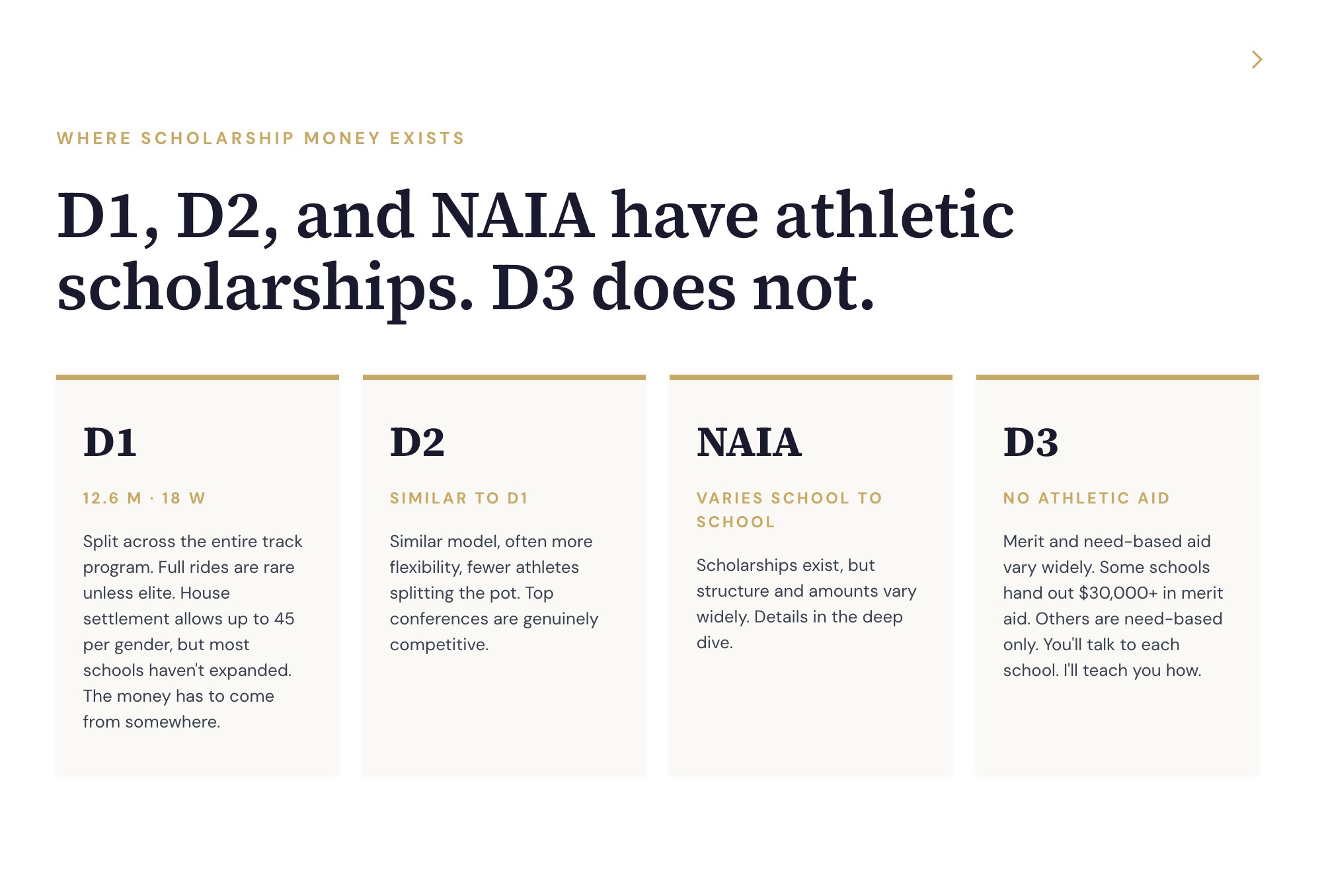
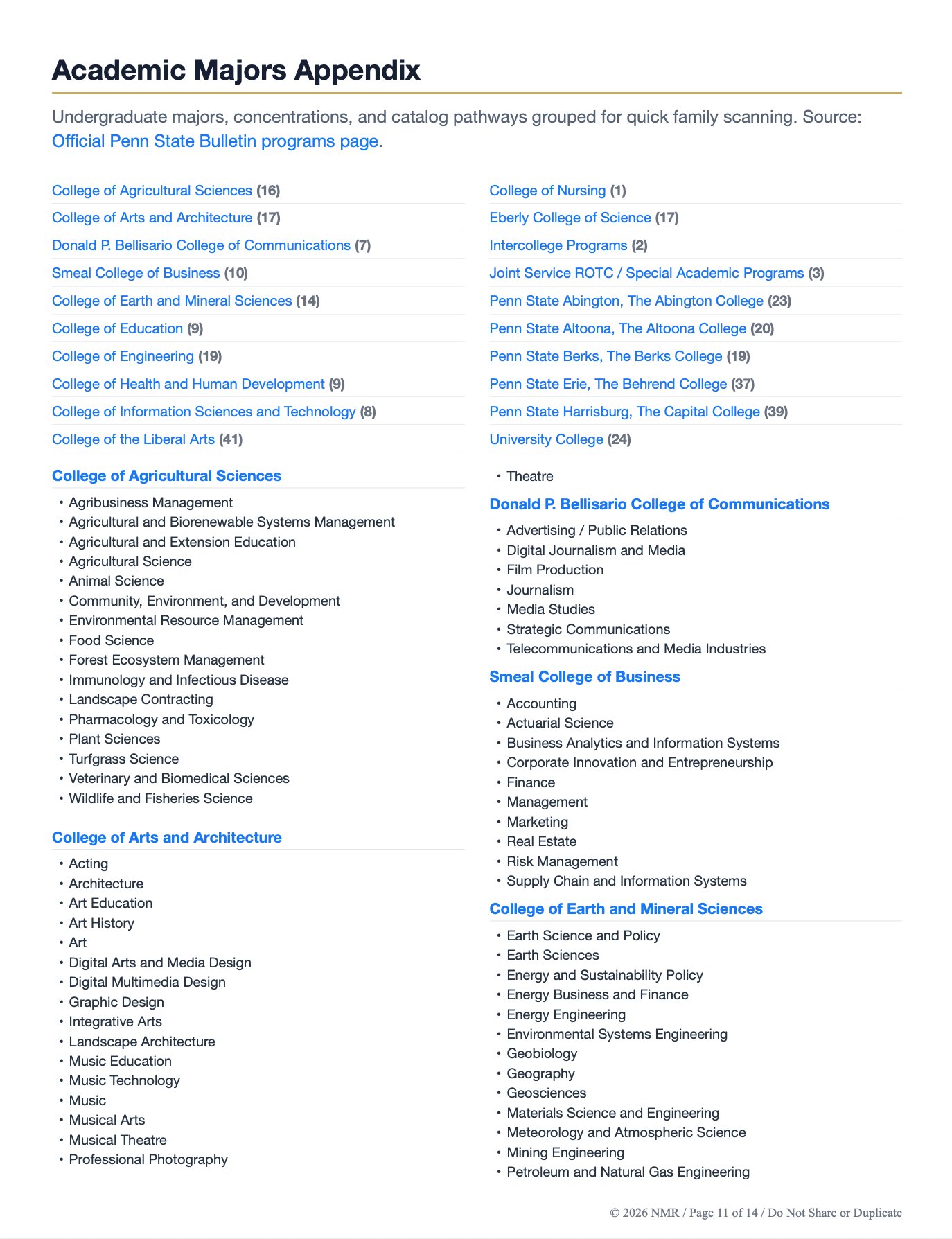
After the core, you watch only the division deep dives that match your athlete. D1, D2, D3, NAIA, JUCO. Most parents watch two or three. About 20 to 30 minutes more. Because so much information is gender specific, some modules are split by gender — you only watch what applies to your son or daughter.
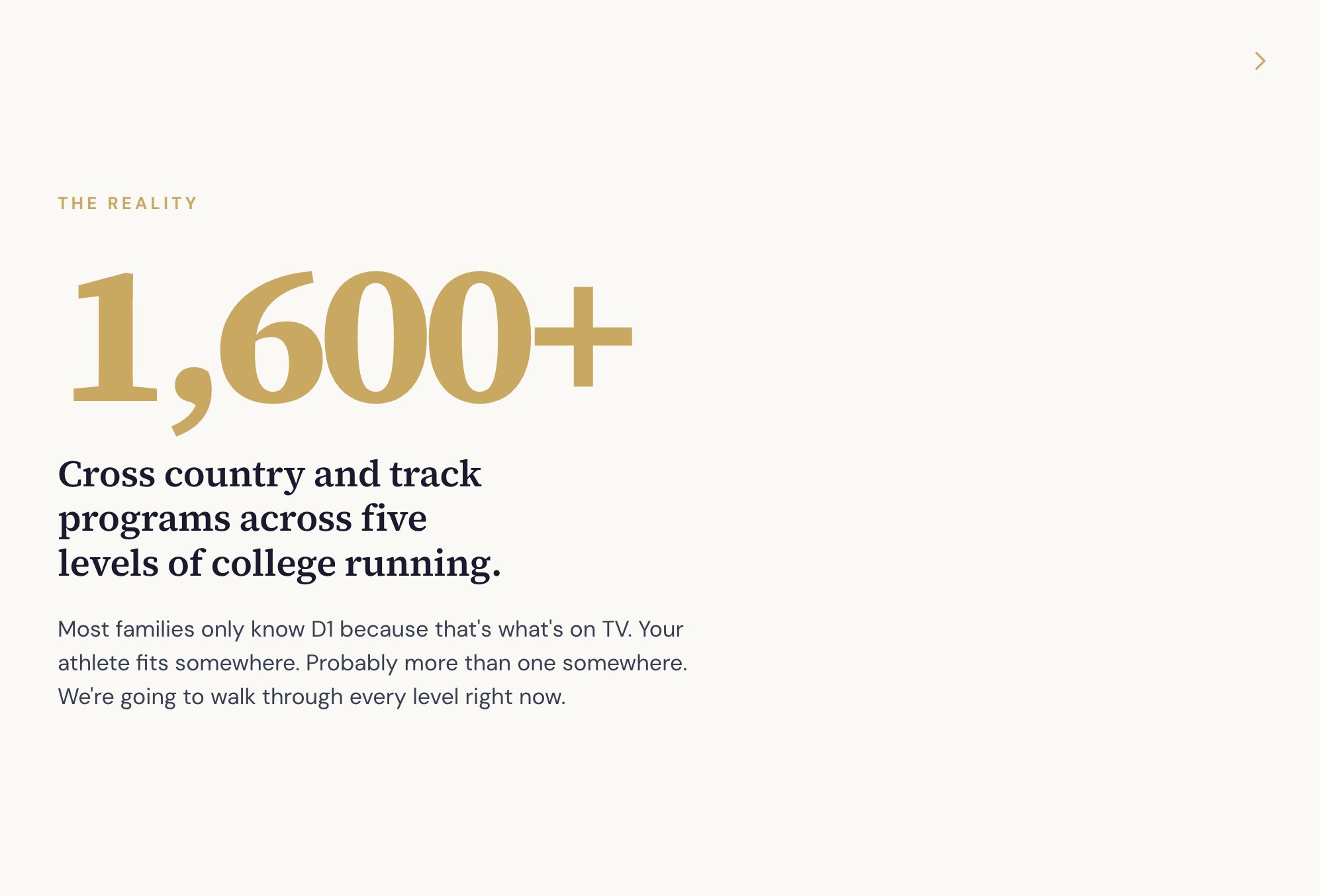
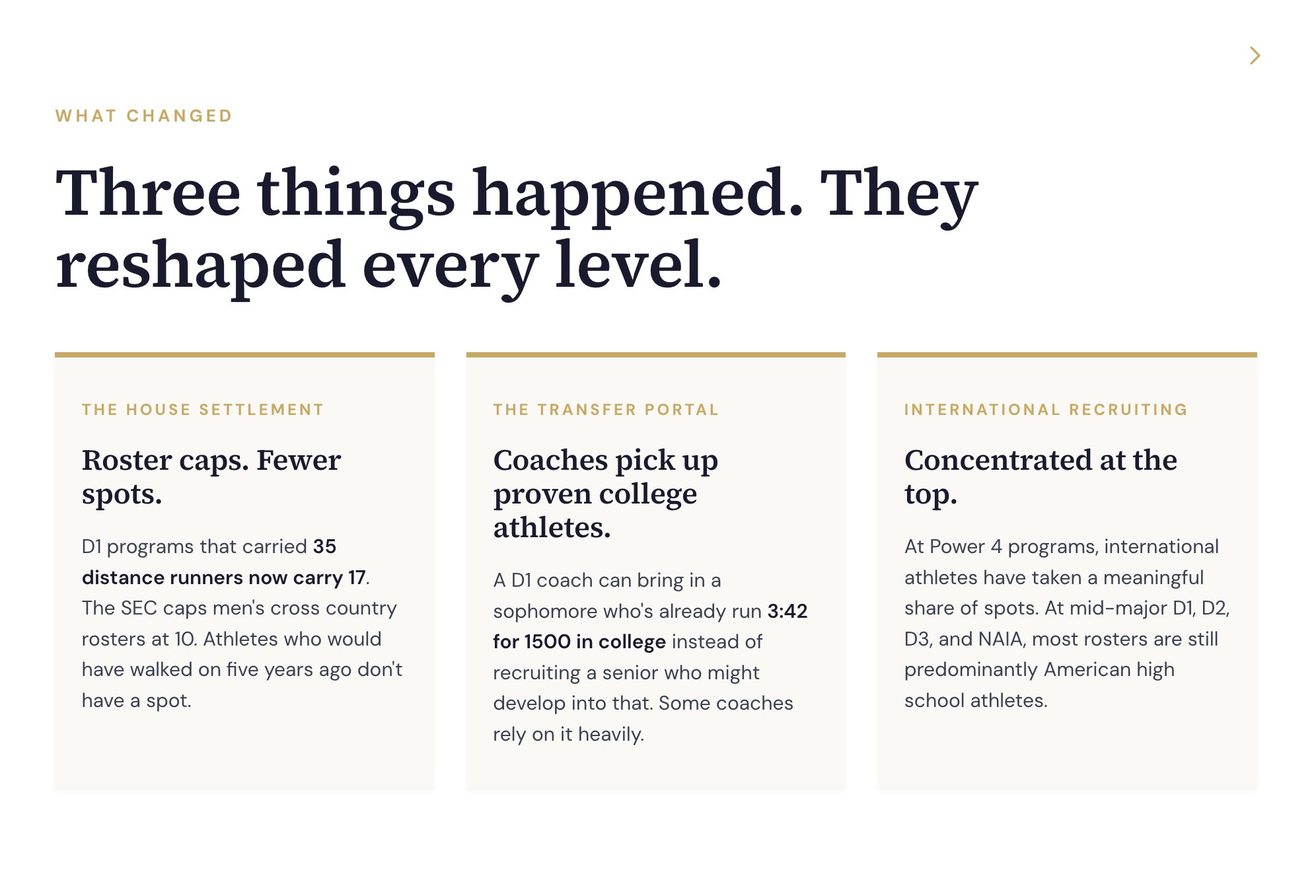
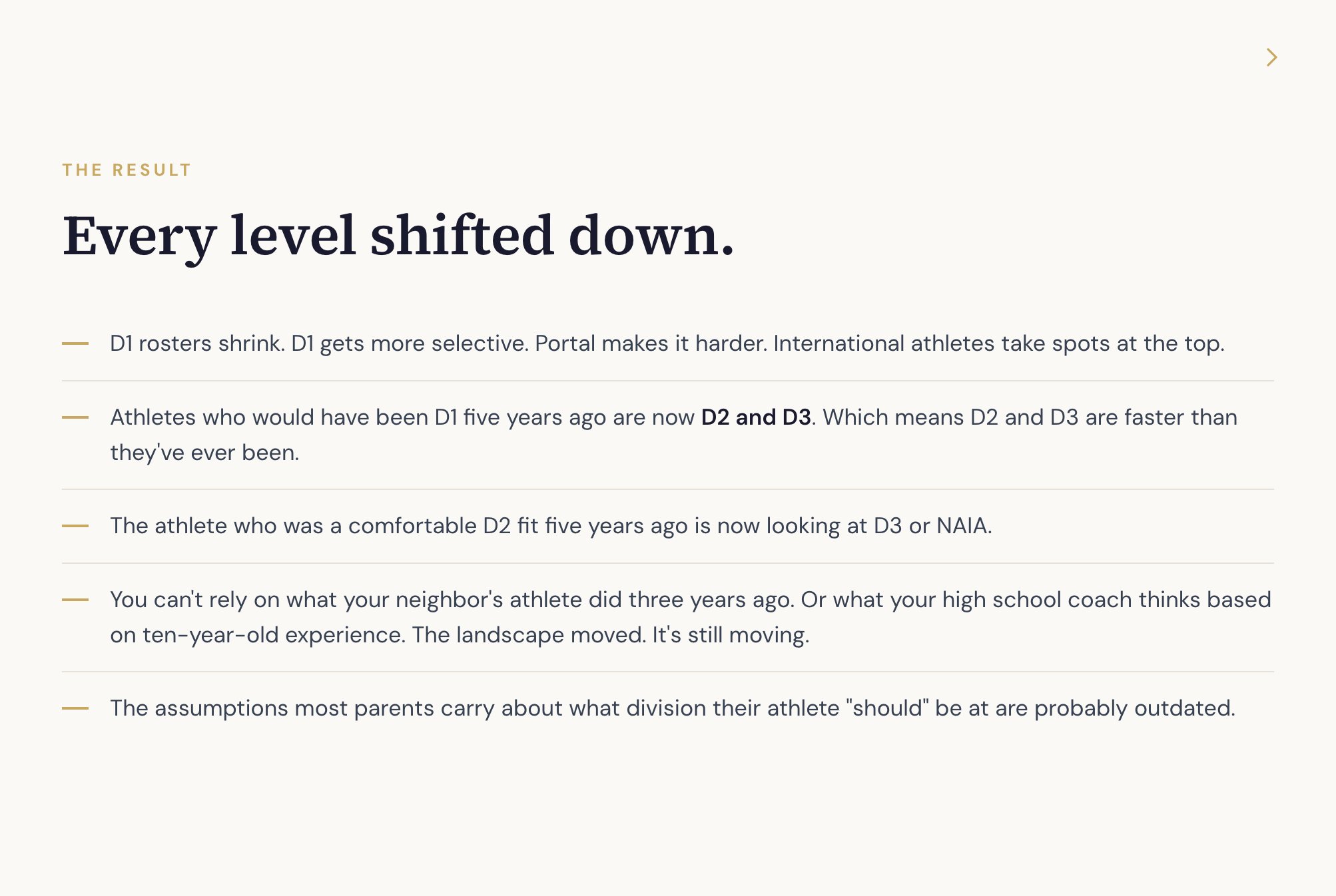
By the time you finish the videos (Saturday morning for most parents), the fog is gone. You understand the recruiting calendar, what coaches actually want, and what changed in the sport in 2025 with the House settlement. You know what to do next, and why.
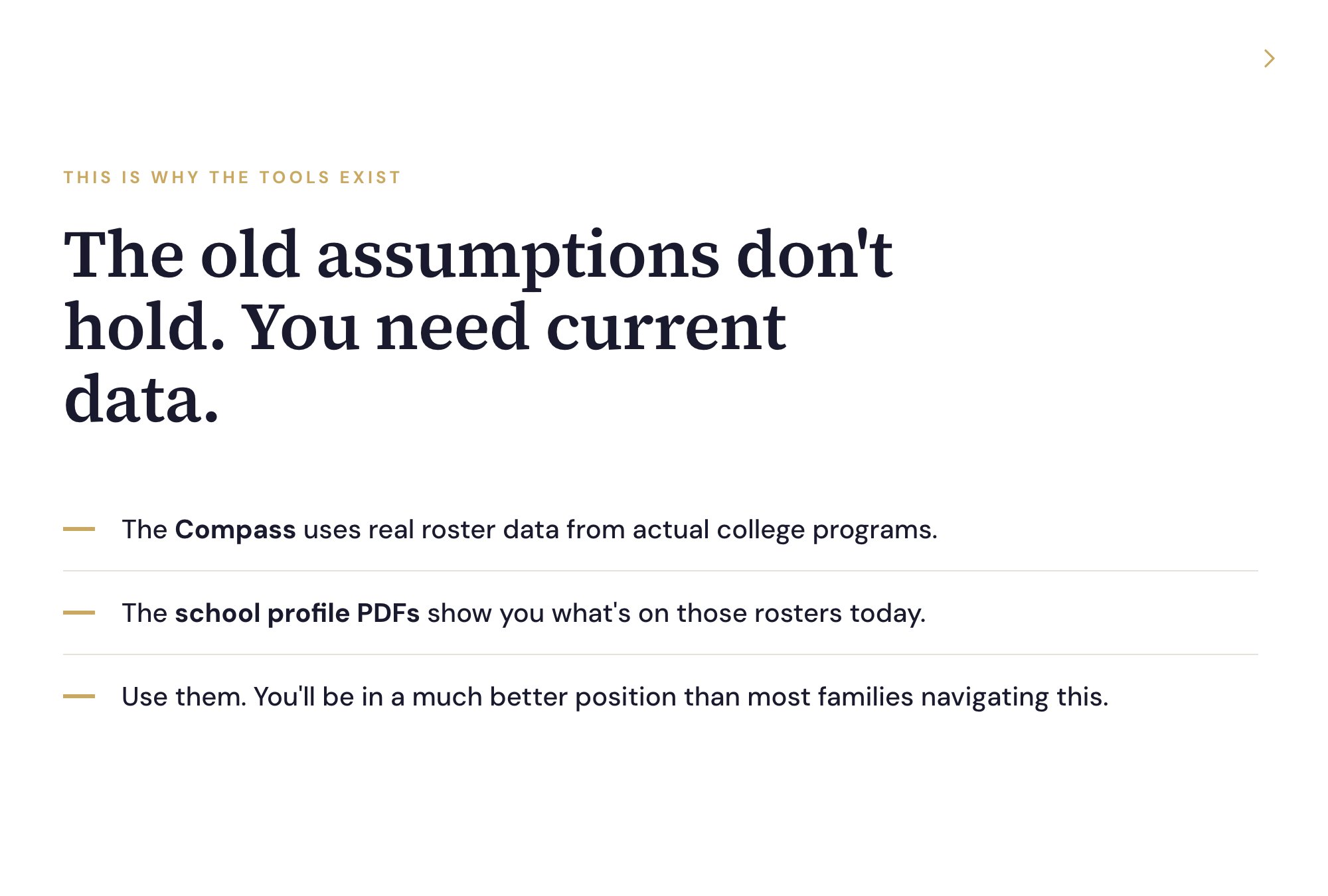
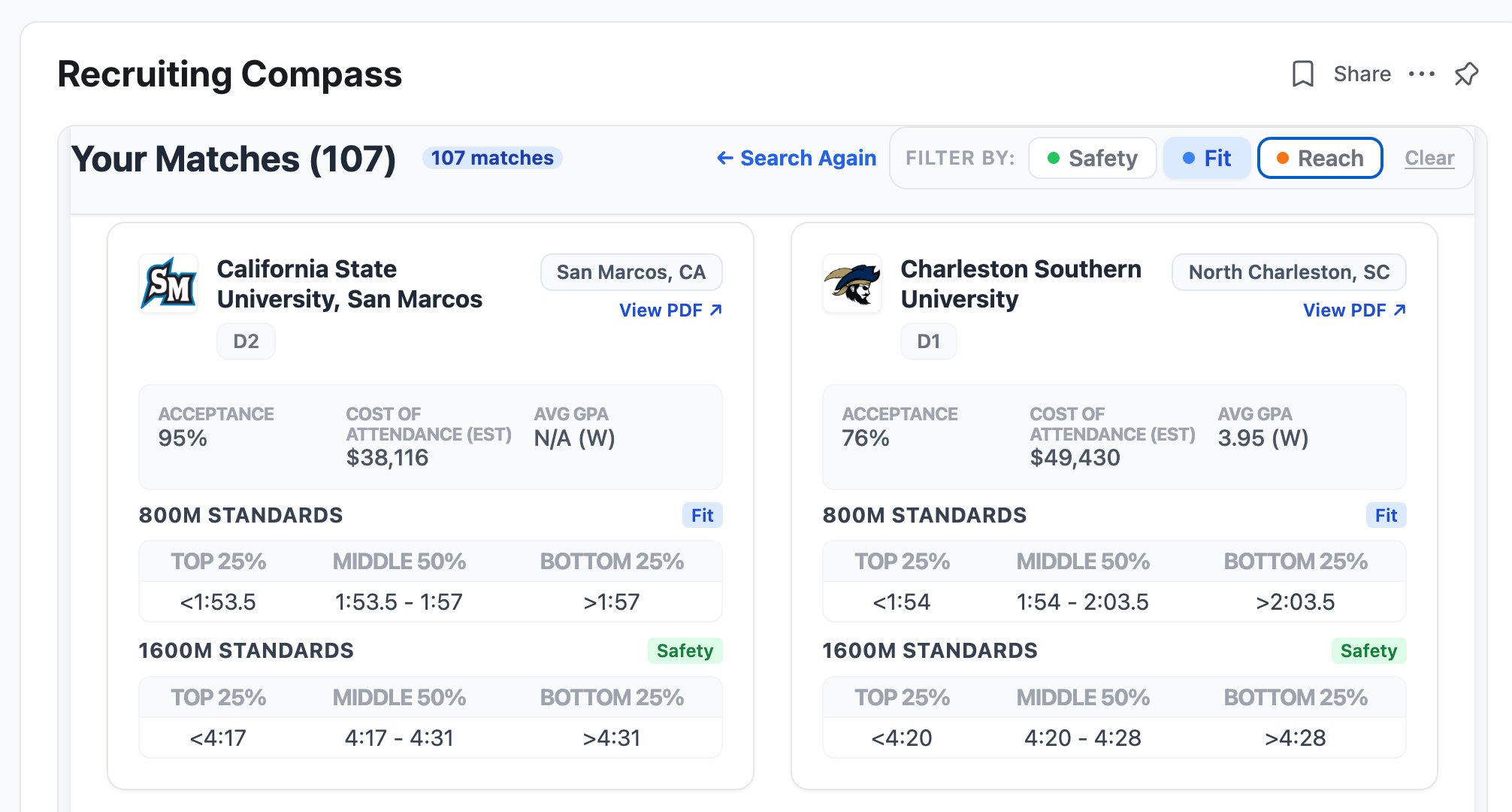
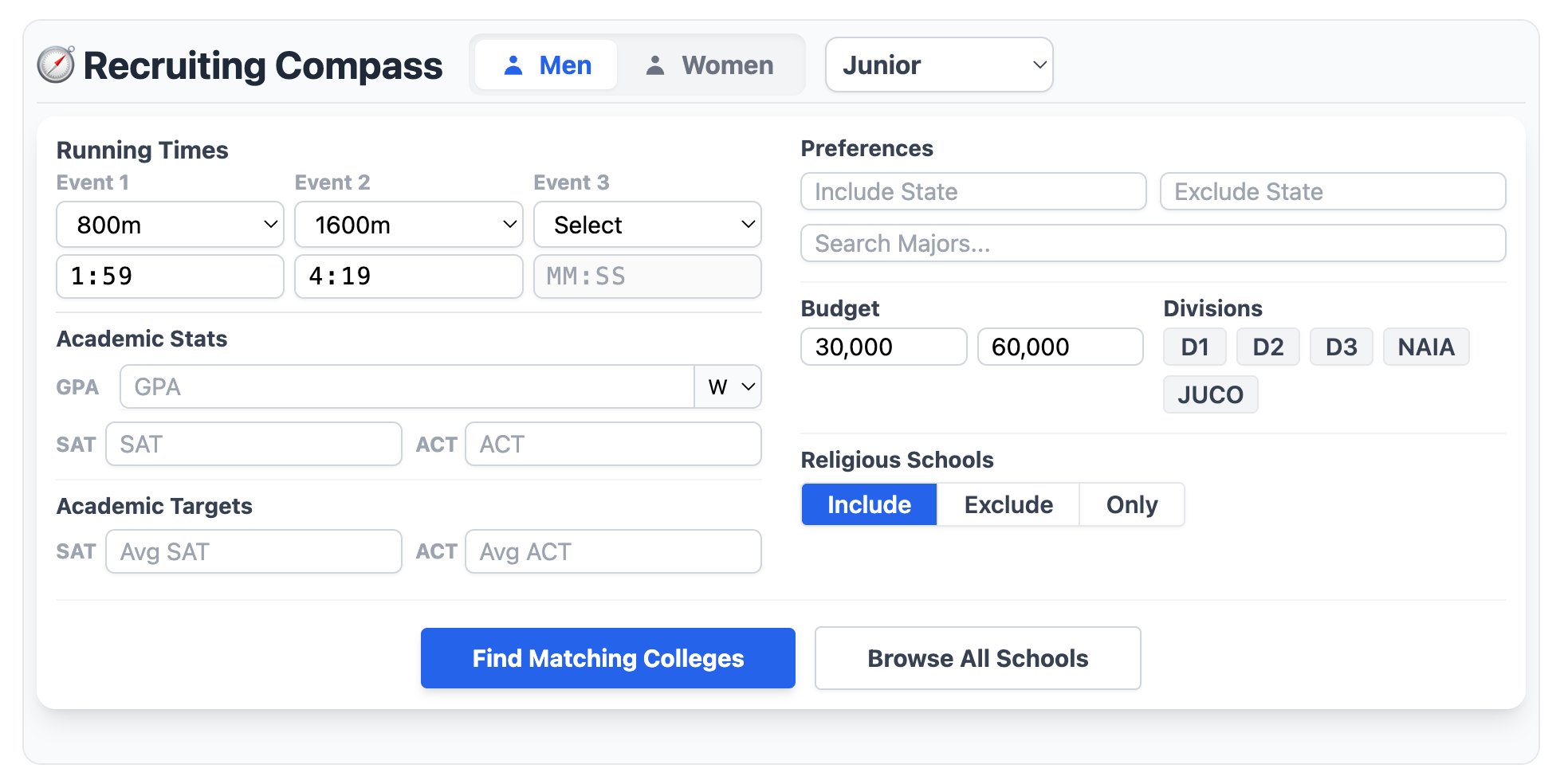
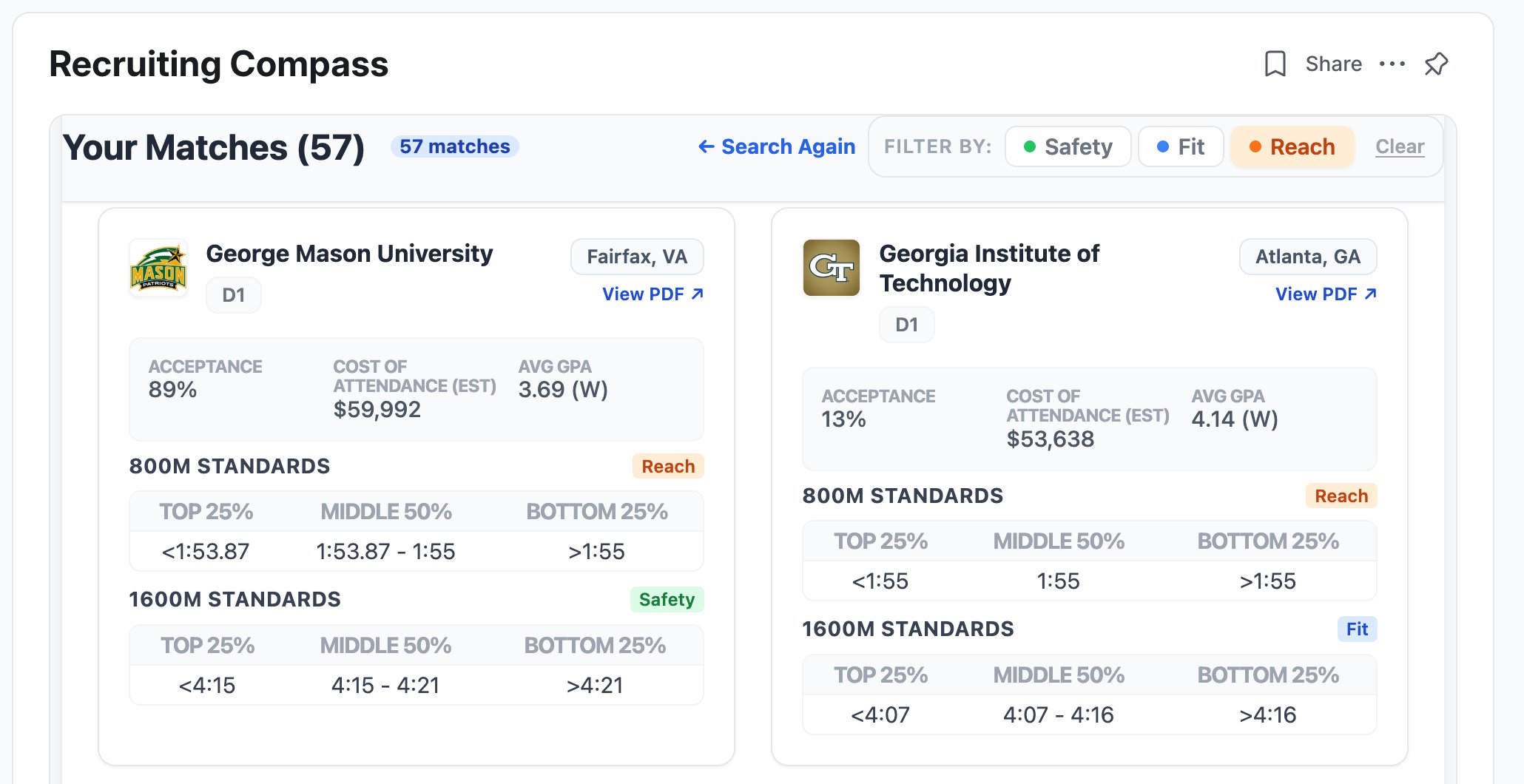
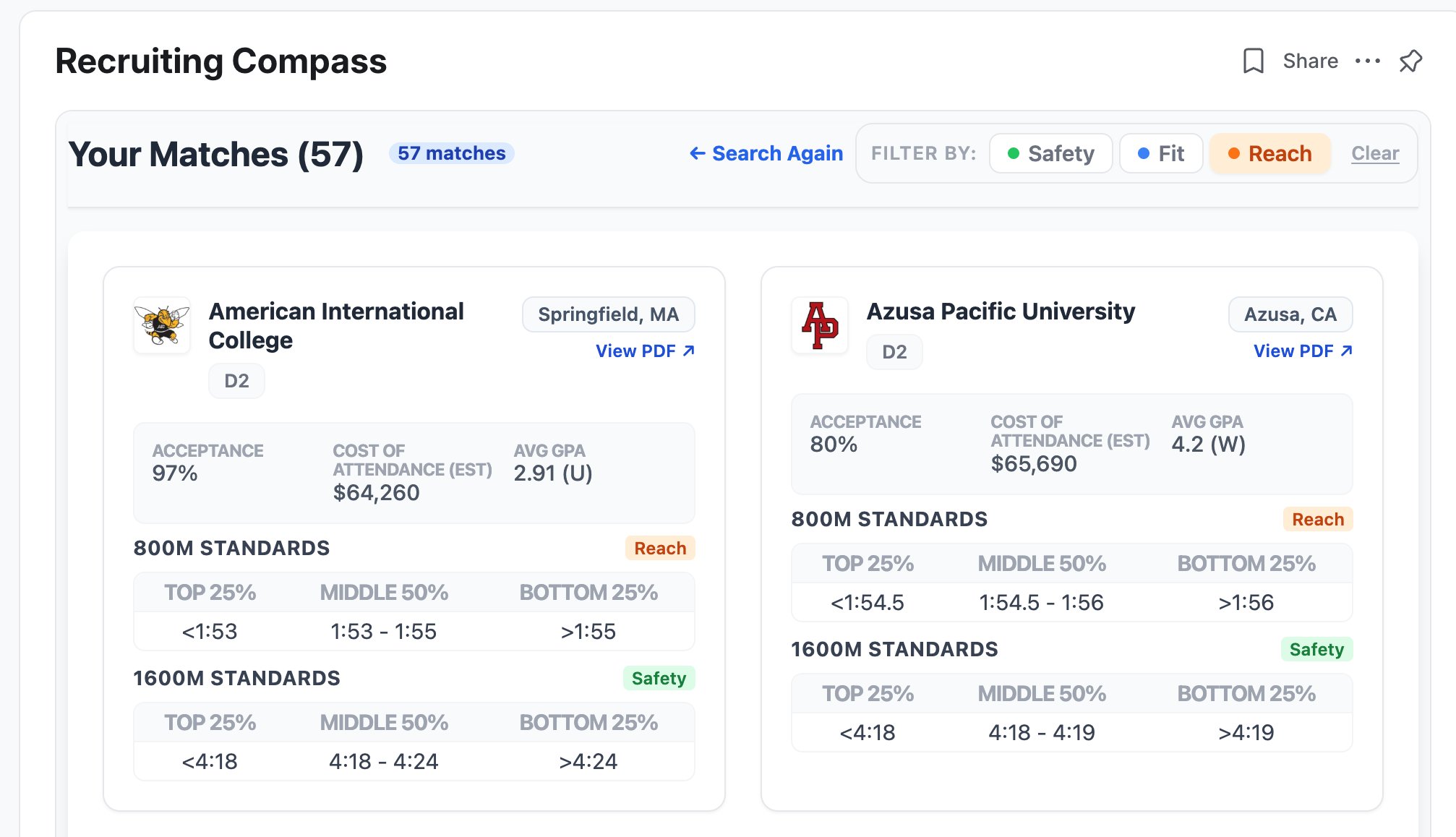
The Compass is what most online tools claim to be and almost none of them actually are. It’s accurate. It’s up to date. It lets you enter your athlete’s PRs, GPA, geographic preferences, and the financial range your family can work within.
It then gives you a list of college programs across every division that genuinely fit, surfacing information you wouldn’t otherwise be able to find online and saving you 30 to 40 hours of Googling and trying to piece things together.
The matching is built on real roster data, not published performance standards. The output uses the same vocabulary you already use for academic college planning: reach, fit, safety. And every program on the list comes with the basics already in place. Division. Conference. Head coach.
There’s a reason no other tool can do this. The data behind the Compass didn’t exist in this form before I built it. I spent eighteen months gathering and verifying it, organizing it around the parent’s question instead of the coach’s. The Compass is what that work makes possible.
You’ll see schools you didn’t know existed. You’ll see schools you’d dismissed for the wrong reasons. You’ll see your real options, in front of you, on one screen, in about forty minutes.
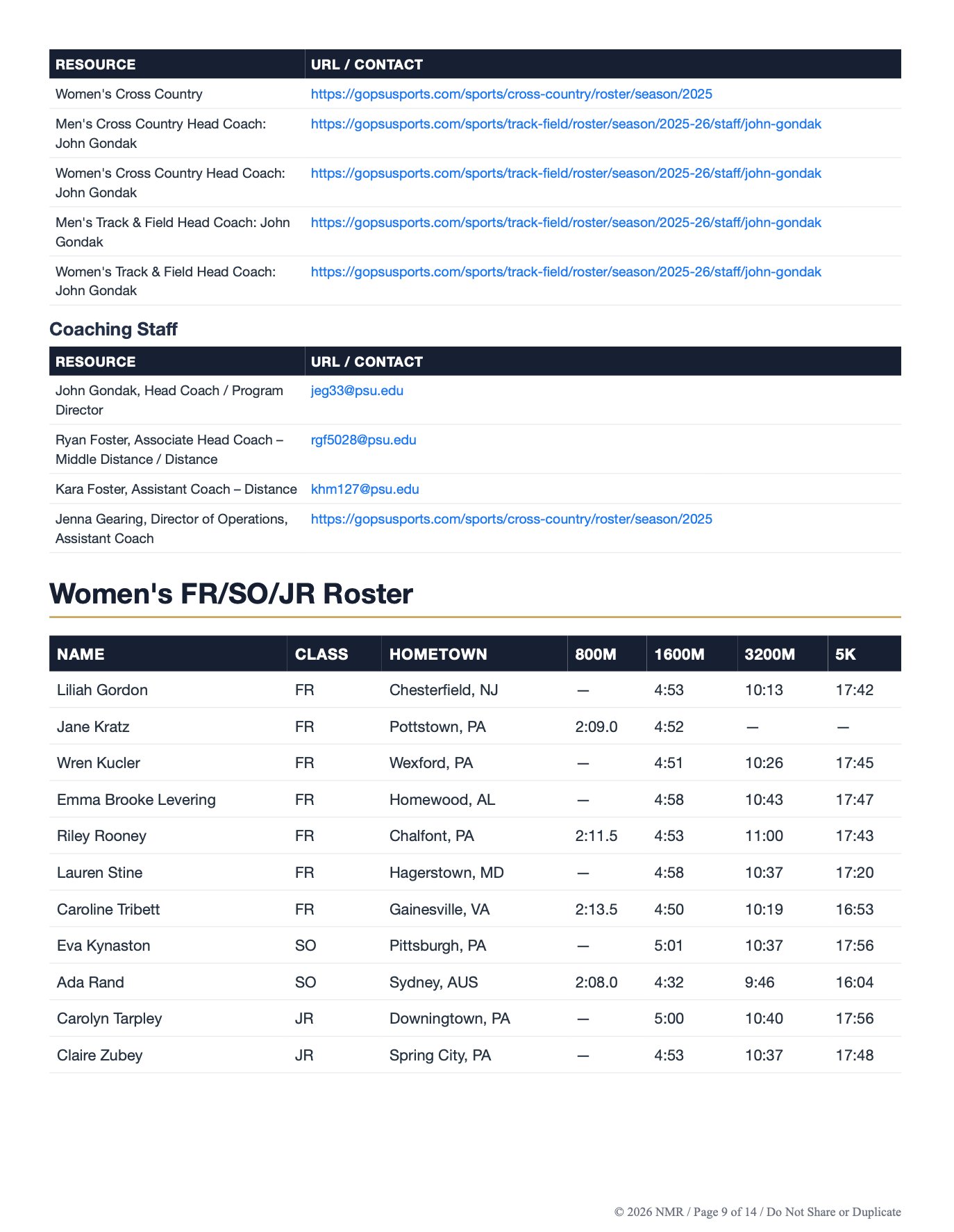
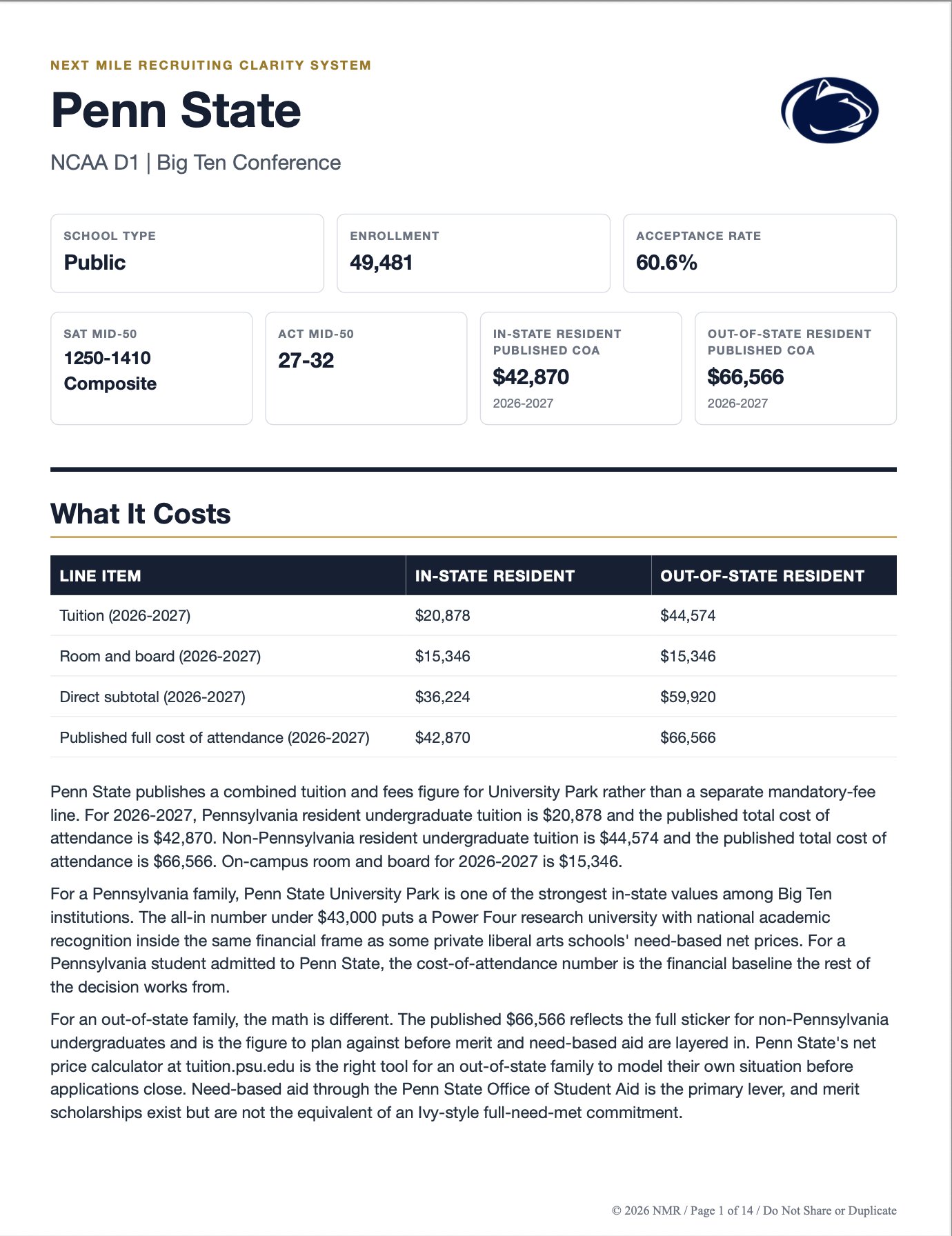
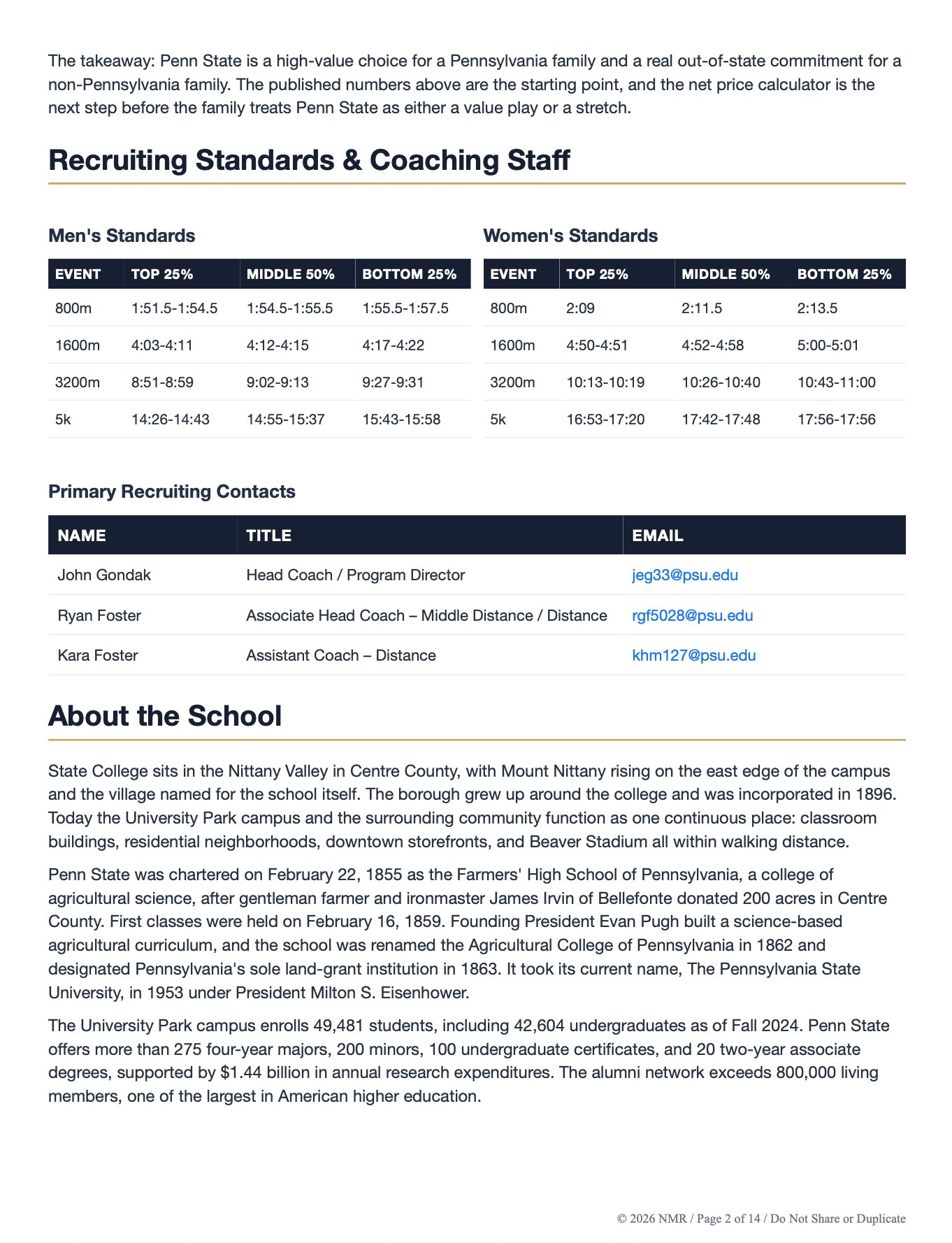
For programs you identified in the Compass that match your athlete most closely, you get a full report on each one. Inside each report:
Each report opens with a concise introduction you can skim in a few minutes, so you can rank and prioritize quickly, then go deep on the four or five schools that matter most.
By Sunday morning, with a cup of coffee, most parents read through 4–5 full reports and feel ready to make a real decision about who to email first.
Conversations with college coaches across every division. D1, D2, D3, NAIA, and JUCO. Programs you’ve heard of and programs you haven’t. They tell you, in their own words, what they look for in recruits, how they read parent emails, what timeline they’re working on, what scholarship money actually looks like at their school, and what gets a kid cut from their list.
You can listen on your phone while you’re making dinner or driving to work. These are coaches telling you what they think and what you need to know.
These don’t exist after the launch closes. They’re the difference between a course and a coached experience.
One-on-one with me, redeemable any time starting August 1, 2026. Most families will want to bank it for senior year, when you’re down to a final list — but use it whenever it helps, whether that’s after your first coach reply or in the fall when you’re choosing between three programs.
Once 25 calls are claimed, this bonus closes for the launch.Every Clarity System buyer gets a private channel inside the member area. Post any question that comes up — athletic, financial, academic, “is this email any good before I send it.” I respond within a couple of business days.
Open through September 2026.That’s the price for this first-ever Founder’s Launch of the Clarity System.
Once the Founder’s Launch ends, the price goes up to $975.
The eventual price will sit between $1,500 and $2,000.
The Clarity System is built around the realistic time budget of a parent who has a job, other kids, dinner to make, and a meet on Friday. Not a course you’ll “get to someday.”
Set up your account. Skim what’s inside. Bookmark the page for tomorrow.
After dinner. Four videos: the calendar, what coaches want, the email, how to use the Compass.
Coffee in hand, open the Compass. Enter PRs, GPA, geography, budget. Get a dozen real fits.
Sunday morning, 4–5 full school profiles. Decide who to email first. Draft those emails.
Before school. Five thoughtful, informed messages to the right coaches at the right schools.
Total: five to six focused hours. Spread across a weekend.
One weekend, and you’re moving.
The Clarity System is coming soon
The Clarity System works because it’s built on verified data, not estimates. The roster information in the Compass is current — checked against this season’s actual rosters.
The school reports are up to date with the 2026–2027 tuition and fee numbers, the current coach’s contact information, and this year’s roster, so you can see for yourself how fast a team’s freshman class was last year.
The course teaches:
The coach interview library is what tells you whether the framework I’m teaching you is real. Because you’ll hear the coaches confirm it themselves.
“Will there be founder’s launch pricing?”
I’m offering the first 25 people to enroll a 60-minute 1:1 call with me. You can use it any time during your recruiting journey. Once those 25 calls are claimed, that bonus is gone.
The $875 Founder’s pricing will be the launch price regardless of how many calls have been claimed. After the Founder’s Launch, the price goes up to $975.
“My athlete is only a sophomore. Is this too early?”
It’s not too early. For sophomore parents, the Clarity System does two things. It gives you a clear-eyed read on where your athlete sits at every division based on current PRs. And it gives you a roadmap for what to do over the next 18 months. Most families won’t be emailing most coaches yet, but you’ll know which schools to track and what PRs would change which doors open.
“My athlete is a junior and hasn’t emailed coaches. Is it too late?”
No. Not at all. That said, you need to get going and contact coaches in June. Whether your child has humble PRs or ran some huge PRs in May, you don’t want to wait. All the D3 coaches at the elite schools want to do a pre-read in June. Many D1 schools want to schedule the visit in September.
I don’t want to scare you. The first week of June isn’t too late to be emailing coaches if your child is a 2027 grad. The flip side is that you don’t want to send that first email in July or August.
“Won’t a recruiting service do all of this for me for $4,000?”
They’ll try, and they won’t deliver. They don’t have access to the data that drives the Compass tool, because that data didn’t exist in this form before I built it.
But the bigger issue is what you actually want. You want advice from someone who’s been a college coach, and who talks to college coaches weekly. If your goal is to hand the process to someone else who played another sport in college and was hired by a recruiting service to help athletes in all sports, or perhaps was a track athlete but wasn’t a distance runner, you can find them.
They can’t do anything for your child that you can’t learn to do.
I’ve had to go out of my way in the past 18 months when I explain Next Mile Recruiting to college coaches and high school coaches. I lead with, “This won’t be a recruiting service. It’ll be an educational offering to teach parents what to do. We both know that services can’t get a kid on a roster or get them a scholarship if they haven’t run fast enough.”
Why do I make sure to clarify that? Coaches at both levels hate recruiting services. They’ve watched these companies mislead families with a false premise that they can get an athlete a roster spot or a scholarship. It doesn’t work that way.
The Clarity System gives you the information, the framework, and the templates so that you and your athlete are equipped to drive your own process.
“I’m not very techy. Is the Compass complicated?”
No. You enter your athlete’s PRs, their GPA, the states you’re open to, and a financial range. The Compass returns the list. The course includes a video walking through exactly how it works. If you can use a computer, you can use the Compass.
“What about athletes who run events outside 800m to 3200m?”
The Clarity System currently focuses on athletes whose events fall in the 800m through 3200m range, plus cross country. If your athlete’s primary events are 400m or shorter, this isn’t built for you yet. But I’m tracking interest for adding the sprints, hurdles, and field events version for a fall 2026 release.
“What happens to the founder’s launch price after it closes?”
The price goes up to $975 immediately after the Founder’s Launch closes. Long term, the price will sit between $1,500 and $2,000. The $875 founder’s price is the lowest this system will ever be sold at. If you’re on the fence about timing, that’s the part to factor in.
“How long do I have access to the Clarity System?”
Your family has access through June 30 of your athlete’s senior year. The Clarity System is built to be used in the kitchen this weekend and again every time something changes: a new PR, a coach goes quiet, a financial aid letter doesn’t match what the coach said. You don’t lose access in 12 months.
“What if it doesn’t work for our situation?”
Email us. We’re a small team, and if the Clarity System genuinely isn’t a fit for your family’s situation, we’ll make it right.
The thing we can’t do is run faster for your athlete. But the rest — the schools that fit, the emails coaches will respond to, the timeline that gives you real options — that’s what this is built to deliver. If you’re not getting that, tell us. We want to know.
If any of these apply, you’re the parent I built this for.
$875 founder’s price · $975 after the launch
The Clarity System answers that question. Not in a vague, motivational way. A dozen schools. Five emails. By Monday morning.
If your weekend is open and your athlete is a 2027 or 2028 grad, this is built for you. Founder’s launch pricing will be announced soon.
If your athlete is a 2027 or 2028 grad who wants to run in college, you need this system.
If you’ve already started a spreadsheet that you can’t seem to finish, you need this system.
If you’ve sent emails to coaches and heard nothing back, you need this system.
I built this because I watched too many good families make the wrong decisions for the right reasons.
And I’m pricing the founder’s launch at $875, well below where it’ll sit after the launch closes. This is the lowest price the Clarity System will ever be offered at.
$875 founder’s price · $975 after the launch
Payments as low as $75/month when you choose Afterpay
One weekend. A dozen schools.
Five emails Monday morning.
Founder’s Launch opens soon — check back to be among the first families in.
Have questions? Email us at info@nextmilerecruiting.com and we’ll get back to you promptly.